Indoor Cat Enrichment: DIY Toys, Routines & Home Setup
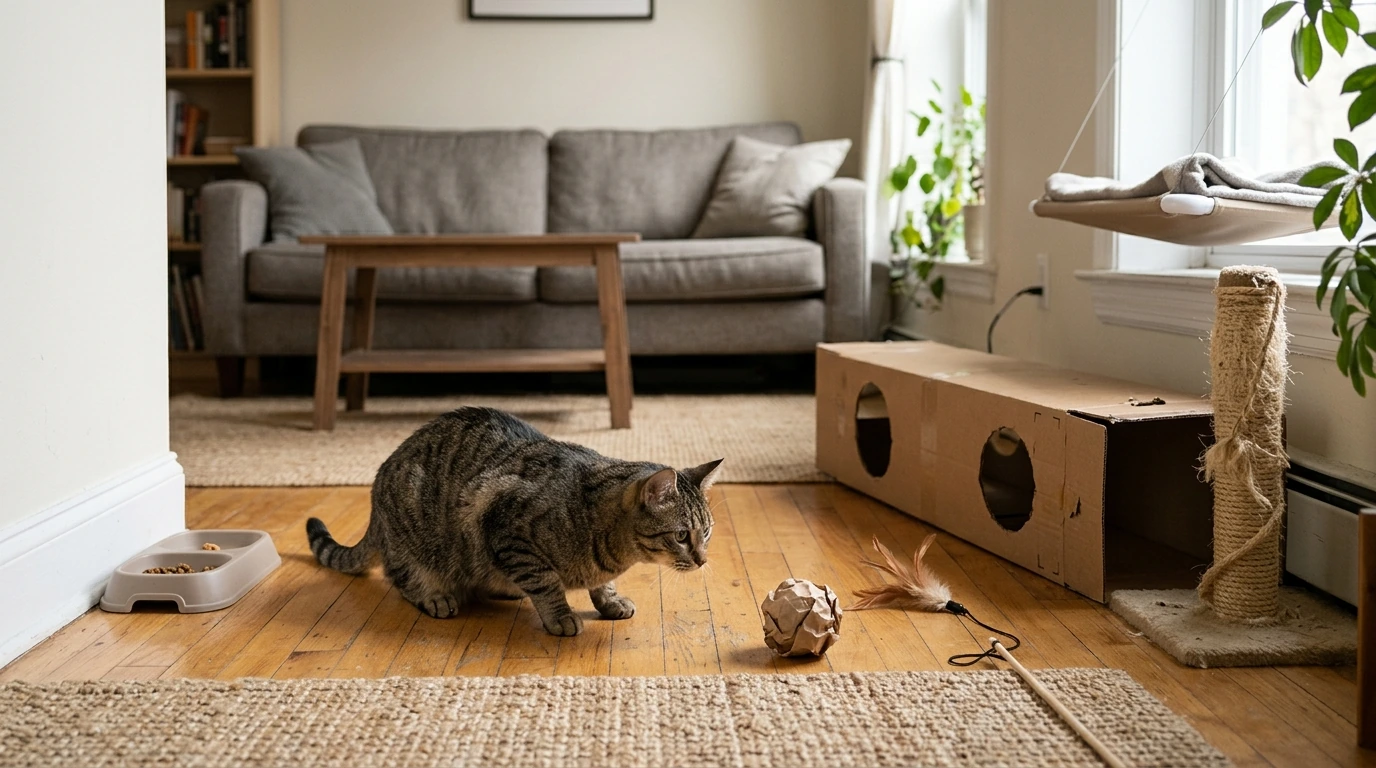
Enrichment Ideas for Indoor Cats: DIY Toys, Daily Play Routines, and Cat-Friendly Home Tips
Indoor cats do best when their day includes a few “hunt-like” bursts of play, chances to climb and scratch, and small brain-engaging jobs that feel meaningful. A little structure goes a long way: predictable routines lower stress, and rotating options prevents boredom without turning your home into a toy store. Below are practical enrichment ideas—simple DIY toys, repeatable play routines, and home setup tweaks—that work in apartments, busy households, and multi-cat homes.
Why indoor enrichment matters
- Supports healthy weight and muscle through movement, sprinting, and jumping.
- Reduces boredom behaviors like excessive vocalizing, night zoomies, chewing cords, or scratching furniture.
- Builds confidence and lowers stress by offering predictable routines and safe outlets for instincts.
- Improves human–cat bonding with short, consistent interactive sessions.
Many cat behavior organizations emphasize enrichment as a core part of wellness, not an “extra.” Helpful overviews include the ASPCA’s guidance on enrichment for cats and the AAFP/ISFM Cat-Friendly resources.
Quick signs a cat needs more stimulation
- Play interest fades fast unless the toy moves like prey (darting, hiding, pausing).
- Over-grooming, door-dashing, or stalking feet/hands as “moving targets.”
- Fixating on windows with agitation (chattering, tail twitching) without an outlet afterward.
- Meowing at night or waking the household for attention.
- Destructive scratching despite having scratchers (often placement or variety is the issue).
The 5 pillars of a well-rounded enrichment plan
- Hunt/play: short interactive sessions that end with a small “catch” (treats or a meal).
- Food puzzles: slow feeding and foraging that mimics searching and problem-solving.
- Climb/perch: vertical territory—cat trees, shelves, window perches, and safe routes.
- Scratch/mark: multiple textures (sisal, cardboard, carpet) placed where scratching already happens.
- Scent and novelty: toy rotation, safe scents (catnip/silvervine), and occasional “new” boxes or handle-free paper bags.
DIY toys and activities using everyday items
DIY enrichment works best when it’s easy to repeat. Keep a small “cat activity bin” so you can set something up in under a minute.
- Paper “prey”: twist paper into a loose ball, drag it on a string, then let it hide under a towel edge.
- Box obstacle course: connect 2–3 boxes with entry holes; add crumpled paper for rustle and hiding.
- Treat towel roll: sprinkle kibbles into a towel, roll it, and loosely tie for a foraging challenge (supervise at first).
- Sock kicker: stuff a clean sock with crinkle paper; tie off securely for bunny-kicking.
- Bottle cap hockey: slide caps across a smooth floor; use a hallway as a mini rink.
- Rotation rule: put 70–80% of toys away and swap weekly so old toys feel new again.
DIY enrichment safety checklist
| Item | Use it for | Avoid if | Safer tweak |
|---|---|---|---|
| String/ribbon | Wand-style supervised play | Cat chews or swallows fibers | Use only during play; store immediately after |
| Plastic bags | Crinkle sound play | Cat bites/ingests plastic | Use paper bags (no handles) or crinkle paper |
| Small parts (bells, eyes) | Toy add-ons | Any risk of detaching | Choose stitched, larger components; inspect weekly |
| Rubber bands/hair ties | Chase/throw | Common to swallow | Replace with felt balls or large pompoms |
A simple play routine that fits real life
Consistency beats marathon sessions. Aim for 2–3 short sessions daily (5–10 minutes each), and treat them like “mini hunts” instead of random waving.
- Use the prey sequence: stalk → chase → pounce → “kill bite” → eat → groom/nap.
- End with food: a small snack or part of a meal creates a satisfying finish and reduces post-play frustration.
- Change the pattern: low-to-ground darts one day, vertical leaps the next, then a slower “hide and peek” day.
- Multi-cat tip: offer parallel play (two wand toys) to reduce competition and ambushes.
If you like having a repeatable plan on the fridge, the Enrichment Ideas for Indoor Cats | Printable Cat Enrichment Guide | DIY Toys, Play Routines, and Cat-Friendly Home Tips lays out a ready-to-use mix-and-match structure that makes it easier to stay consistent.
Cat-friendly home tips that prevent boredom
For additional behavior and wellness context, the Cornell Feline Health Center is a solid reference for how health, stress, and behavior can connect.
Enrichment for different cat personalities
A ready-to-use way to keep it consistent
If scheduling is the hardest part, pairing a cat routine with a simple planning system can help you stick with it. The AI-Powered Days: Master Your Schedule with Smart Automation can be a useful way to turn “we should play more” into a repeatable daily habit.
Common problems and easy fixes
FAQ
How much play does an indoor cat need each day?
Most indoor cats do well with 2–3 short play sessions a day (about 5–10 minutes each). Adjust based on age and energy level, and try to end with a small “catch” like a treat or part of a meal.
What are safe DIY cat toys to make at home?
Good options include paper balls, box forts, a sock kicker (tied securely), and a supervised treat towel roll. Avoid loose strings when unsupervised and skip small parts that could detach and be swallowed.
How can enrichment help with nighttime meowing or zoomies?
Evening enrichment taps into the natural hunt–eat–groom–sleep rhythm. A short interactive play session followed by dinner (plus daytime foraging) often reduces pent-up energy that spills into nighttime noise and running.





Leave a comment