AI Problem-Solving Checklist: Clarify, Test, Decide Fast

AI Problem-Solving Power-Up Checklist: A Practical Routine for Stronger Critical Thinking
A clear checklist can turn AI from a quick-answer machine into a structured thinking partner. The goal isn’t to outsource judgment—it’s to create a repeatable routine that helps define the real problem, test assumptions, generate better options, and choose next steps with confidence.
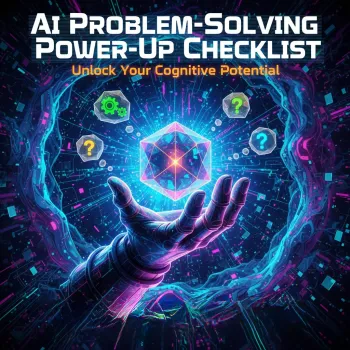
If you want a ready-made version you can reuse daily, the AI Problem-Solving Power-Up Checklist (digital download) is designed to run through this exact loop in a clean, practical format.
What the Power-Up Checklist helps improve
- Problem clarity: convert vague frustration into a specific, solvable question.
- Critical thinking: surface assumptions, constraints, and decision criteria before brainstorming.
- Option quality: generate multiple approaches, compare tradeoffs, and avoid single-solution bias.
- Speed with control: move faster while keeping a repeatable process.
- Communication: turn analysis into a short plan, brief, or explanation for others.
This approach also aligns with widely used guidance on responsible, human-centered AI use, including the NIST AI Risk Management Framework and the OECD AI Principles.
Start with a better problem statement (the 2-minute reset)
Most “AI got it wrong” moments start with a fuzzy input. Before asking for solutions, run this fast reset:
- Write the situation in one sentence, then add: who is affected, what “better” looks like, and by when.
- List constraints (budget, time, tools, policies) and what cannot change.
- Define success criteria (measurable if possible): cost, time, quality, risk, learning value.
- Ask AI to rewrite the problem three ways: narrow, broad, and “root cause” versions—then choose one that best matches what you can actually influence.
- Create a one-line decision question: “Which option should be chosen given criteria A–D?”
That final line matters because it forces a decision frame. Instead of “Help me,” you get “Help me choose,” which naturally leads to comparisons, tradeoffs, and a next action.
The checklist loop: clarify → explore → test → decide → learn
1) Clarify
Ask AI to identify missing information, ambiguous terms, and likely stakeholders. Then decide what you truly need to know now versus what you can defer. Capturing “unknowns” early prevents false precision later.
2) Explore
Request 5–10 solution paths across different categories (process, tools, people, pricing, study method, messaging, etc.). The point is variety, not perfection. You’re trying to escape “the first plausible idea” trap.
3) Test
Have AI stress-test each option for risks, failure modes, hidden costs, and second-order effects (what breaks downstream if this goes right?). Then add your real-world context: incentives, politics, timeline, and constraints AI can’t see.
4) Decide
Score options against your criteria, then pick the smallest next action that generates information (a pilot, a draft, a call, a quick prototype). When in doubt, choose the step that reduces uncertainty fastest at the lowest cost.
5) Learn
After results, update your assumptions list and store what worked as a reusable pattern. Over time, this becomes a personal playbook that makes future decisions faster and more consistent.
| Problem type | AI-assisted questions to ask | Useful output to capture |
|---|---|---|
| Decision under uncertainty | What assumptions drive each option? What would change the decision? What low-cost test reduces uncertainty fastest? | Assumptions list, decision criteria, 1–2 experiments |
| Recurring operational issue | Where is the bottleneck? What are the top 3 root causes? What process change prevents recurrence? | Root-cause tree, revised SOP steps, checklist for prevention |
| Learning or study challenge | What prerequisite gaps are likely? What practice schedule fits time limits? How to self-test effectively? | Study plan, practice problems, self-quiz rubric |
| Creative strategy problem | What are 10 alternative angles? What would a contrarian approach look like? How to validate with real users? | Idea set, positioning options, validation steps |
| Communication breakdown | What are likely misunderstandings? How to reframe for each stakeholder? What questions should be asked first? | Message drafts, stakeholder Q&A list, meeting agenda |
Critical thinking guardrails: keep AI helpful, not in charge
For additional perspective on keeping people in the loop (and the accountability where it belongs), Stanford’s work on human-centered AI is a strong reference point.
Three ready-to-use routines (entrepreneurs, students, professionals)
Entrepreneurs
Run a weekly “constraint scan” (time/cash/attention), then ask AI for 3 growth moves and 3 risk reducers. Choose one measurable experiment with a clear pass/fail signal. To pair problem-solving with day planning, use AI-Powered Days: Master Your Schedule with Smart Automation as a companion workflow.
Students
Turn any topic into a study system: AI generates learning objectives, practice questions, and a spaced review plan; you track errors and misconceptions. For families building consistent habits, the Homework Help Made Easy Toolkit for Parents helps convert “study more” into a repeatable routine.
Professionals
Make it stick: a simple setup for repeatable results
When you want a streamlined printable/digital format that already contains these fields, the AI Problem-Solving Power-Up Checklist (digital download) is built for quick reuse across work, school, and personal projects.
Digital download: quick ways to use the checklist day-to-day
FAQ
Does using AI for problem-solving reduce critical thinking?
Not if it’s used with a checklist that forces clarity, assumptions, criteria, and validation. AI can speed up exploration and critique, but the decision and verification still belong to you.
What information should be avoided when using AI tools for real work or school?
Avoid sharing personal identifiers, client or student records, proprietary business plans, passwords, and confidential documents. When you need help, anonymize details and use placeholders so the structure of the problem is preserved without exposing sensitive information.
How can the checklist be used in under 10 minutes?
Write a one-line problem, list three constraints, and define two success criteria. Ask for five options, pick the top two to stress-test, then choose one next action plus a quick test that will reduce uncertainty.





Leave a comment